

News


UK Investment Conference 2026: Key Takeaways

On Tuesday, 15 September 2026, the 2026 UK Investment Conference was held in Shanghai. The conference addressed the core question: How can Chinese companies invest in the UK effectively and use the UK as a key platform for their global development?"
The conference focused mainly on five key areas:
- Deepening UK-China investment cooperation: Both sides still have significant room for cooperation in areas such as consumer goods, advanced manufacturing, life sciences, digital technology, clean energy and finance.
- Greater focus on localisation when investing in the UK: Chinese companies are shifting from simple market entry towards R&D, production, building local teams and long-term operations.
- Addressing regulation and compliance early: Legal, tax, governance and investment-screening considerations should be built into overall planning from the early stages of a project.
- Financial and cross-border funding support becoming even more important: Financing, capital markets, foreign exchange, cross-border guarantees and cash management have become key elements of establishing operations.
- How choosing the right region in the UK affects long term development: Companies need to choose the right investment location based on industry base, talent, cost, research resources and local government support.
Together, these discussions reflect a shift in the logic behind Chinese companies’ investment in the UK: from entering the UK market to building long-term, compliant and localised operating capabilities in the UK and using the UK as a springboard to expand into broader international markets.
The conference was kicked off with welcome remarks from Gordon Orr, Vice-Chair, CBBC; Lewis Neal, HM Trade Commissioner, Yang Yihang, Deputy Director-General, MOFCOM Investment Promotion Agency, which focused on the the key sectors in UK for two way investment as well as the longer term strategic engagement between the two countries.
Keynote speeches were then delivered by Edward Weeks, Senior Executive Vice President, Deputy CEO of HSBC Bank (China), Liu Jianjun, Deputy General Manager of ICBC (London) plc and John Edwards, Director of the UK Government’s Office for Investment. These offered the audience an understanding of botht the existing framework in place as well identifying future opportunies for businesses.
Finally, we hosted a series of fireside chats throughout the conference, including:
Practical experience along the UK-China trade corridor

As moderated by Gordon Orr, Vice Chair of the China-Britain Business Council (CBBC). The discussion, between Matt Jackson, Principal, Head of UK-China Business at KPMG LLP UK, and Karen Lin, Partner, Outbound Investment Tax at KPMG China focused on Chinese companies’ investment in the UK, covering investment strategy, key sector opportunities and pathways to localisation.
Karen Lin, Partner, Outbound Investment Tax at KPMG China, stressed that companies should clarify their investment objectives as early as possible and plan ahead from a tax, operational and overall structural perspective. Both agreed that companies need to build up local talent, governance systems and market resources earlier in order to achieve long-term, sustainable growth.
Chinese corporates’ investment experiences and successes in the UK
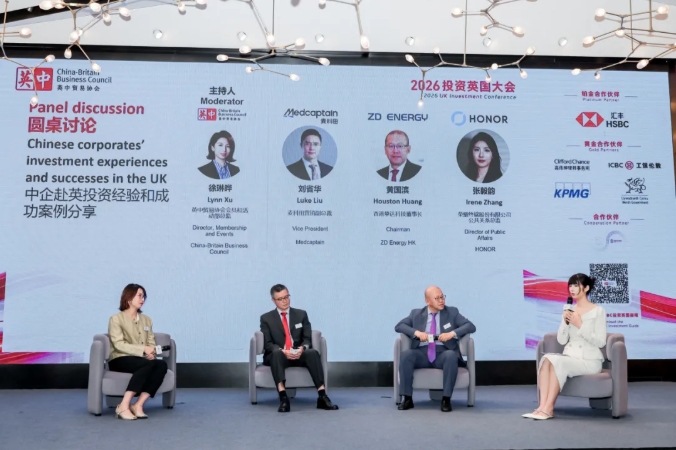
At the panel discussion that followed on the practical experience of Chinese companies investing in the UK, Lynn Xu, Director, Membership and Events at the China-Britain Business Council, moderated the discussion.
Luke Liu, Vice President of Medcaptain, shared his experience of entering the UK market through M&A, arguing that acquisitions help companies gain local products, brands and specialist talent more quickly.
Houston Huang, Chairman of ZD Energy HK, drew on the UK’s energy-transition trends to share his company’s experience in smart charging, energy management, local R&D and partnership building.
Irene Zhang, Director of Public Affairs at HONOR, focused on localisation practices, including building local teams, strengthening communication with partners such as carriers, media and retailers and further integrating into the local market through community events.
Navigating China’s regulatory framework for overseas investment

Tom Simpson, Managing Director, China & China Chief Representative, China-Britain Business Council, moderated the “Navigating China’s regulatory framework for overseas investment” fireside chat, in which Bai Yong, Partner and Head of Antitrust for Greater China, Clifford Chance noted that in recent years, overseas investment screening has shifted from procedural compliance towards a comprehensive regulatory regime covering antitrust, national security, foreign subsidies, industrial policy and supply-chain security, among other factors. Although Chinese companies investing in the UK face closer regulatory scrutiny, the UK market remains open and companies should identify regulatory risks in advance and factor compliance requirements into their investment decisions.
Building a comprehensive entry plan for the UK

Kiran Patel, Senior Director and Deputy Head of China at the China-Britain Business Council, moderated a discussion on “Building a comprehensive entry plan for the UK”.
Tom Attenborough, Head of International Business Development for Primary Markets at London Stock Exchange Group, focused on the role of London’s capital markets in corporate internationalisation, stressing that companies should align their operating strategy with their capital-markets strategy and support global growth by building long-term investor relations.
Alice Du, Managing Director and Head of Corporate for East China at HSBC Bank (China) Company Limited, drew on her experience with the UK China Desk to note that Chinese companies need to plan for the long term and fully adapt to local business rhythms, customer due-diligence processes and bank account-opening requirements.
Wang Ziwen, Associate at Clifford Chance, shared the legal and compliance issues Chinese companies need to watch when investing in the UK, from the perspective of antitrust, foreign investment screening and foreign subsidy regulation.
Karen Lin, Partner, Outbound Investment Tax at KPMG China, stressed that tax and investment structures should be designed in advance based on a company’s strategic objectives for entering the UK.
Sun Libin, Deputy Head of the Cross-Border Business Center (International Syndication Center) at ICBC Shanghai Branch, addressed cross-border financing and cash management, covering practical issues such as onshore and offshore bank structures, cross-border guarantees, foreign-exchange management and cash pooling.
The practical implications for investment of regional differences in the UK economy
Peggy Wang, Senior Wales Affairs Officer at the Welsh Government, introduced Wales’s investment environment and key industries. Wales has built a distinctive industrial base in areas such as life sciences, advanced manufacturing and clean energy and, drawing on its research institutions, industrial clusters and public services, provides support for companies establishing and growing their operations there. Wales has industry clusters in areas such as medical technology and diagnostics and has a strong base in aerospace, automotive manufacturing and related supply chains.
In the final panel discussion, Ben Rotheram, Director, Commercial & Outbound Services, China-Britain Business Council, moderated a discussion on “The real-world impact of regional differences in the UK economy on investment”.
Karen Sun, Shanghai Chief Representative at the Welsh Government, noted that one of the biggest challenges companies face when entering a new market is uncertainty and that local government can help by connecting companies with government departments, professional-services firms, universities and research resources, shortening their learning curve and helping them integrate into the local ecosystem more quickly.
Eddy Tao, Head of China and Business Development Director at Berkeley Group, said that when the group carries out development and selects investment sites in the UK, it focuses closely on transport connectivity and regeneration opportunities in each area. He noted that transport infrastructure can drive population inflows and regional development, in turn creating further real estate investment opportunities. He also said that Berkeley Group has also long been involved in large-scale, government-led urban regeneration projects.
Alison Young, Director, Trade & Investment at Thames Freeport, spoke about the freeport's role in attracting investment and driving regional economic growth. She said Thames Freeport draws on its ports, transport networks and industrial base to focus on developing sectors such as advanced manufacturing, sustainable construction and materials, logistics, consumer goods and digital innovation and helps companies integrate into the local industrial ecosystem more quickly by lowering the cost of establishing operations, strengthening cooperation with local government, and supporting talent development and innovation testing.